Imagine a massive foundation slab stretching the length of a football field, or the steel skeleton of a high-rise needing concrete poured on the 40th floor. The challenge is immediate and immense: how do you get a perishable, heavy material like concrete from the truck to the precise point of placement, hundreds of meters away, both horizontally and vertically, without compromising its integrity or bringing the site to a standstill? This is the quintessential conundrum of modern large-scale construction, and the answer isn’t found in sheer manpower or conventional methods. It is solved with the focused, powerful technology of the concrete line pump for sale, a machine engineered to turn logistical nightmares into streamlined, efficient processes.
The Mechanics of Mastery: How Line Pumps Conquer Distance
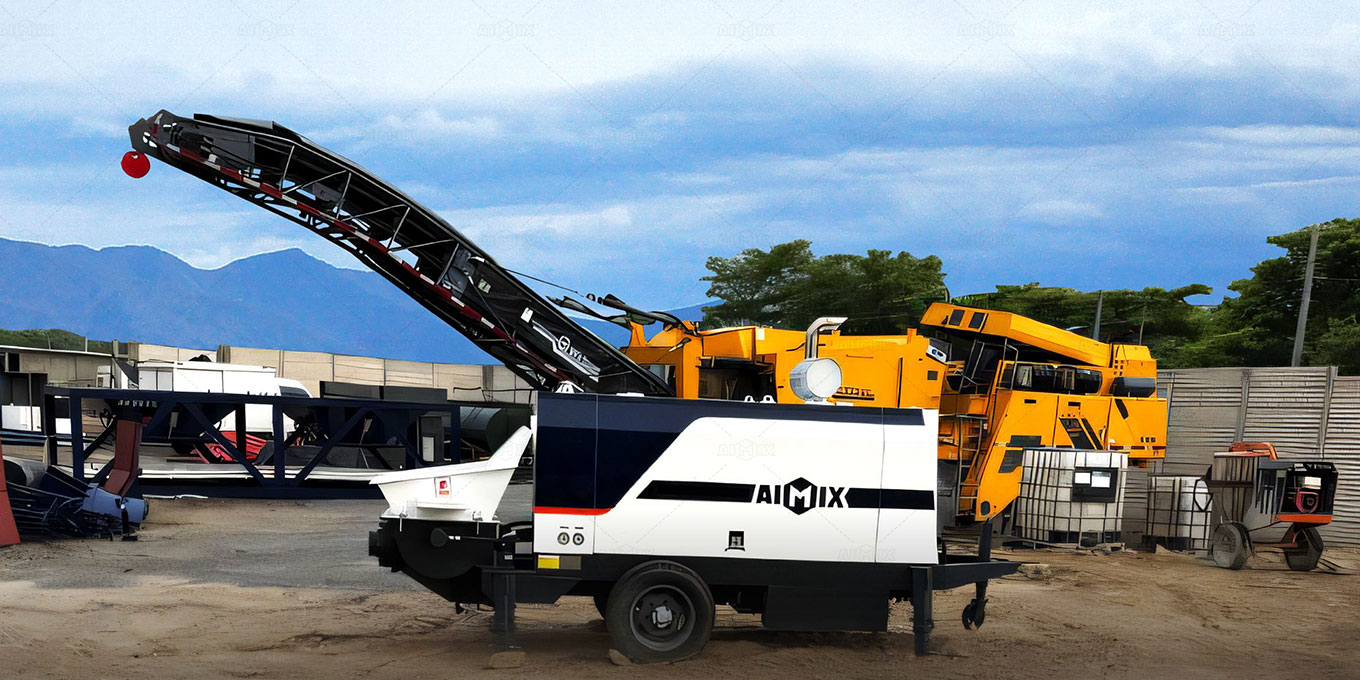
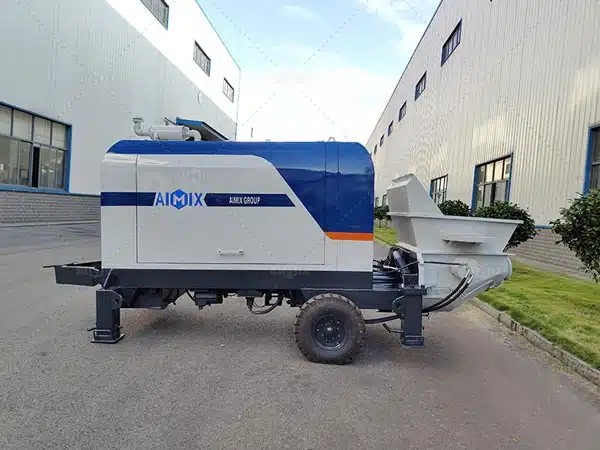
To appreciate its value, we must first understand its brilliant, robust operation. At its core, a trailer-mounted or truck-mounted line pump is a high-pressure hydraulic system. Twin cylinders work in a reciprocating rhythm: one draws liquid concrete from the hopper while the other simultaneously pushes its payload into the delivery pipeline. This alternating piston action creates a continuous, non-pulsating flow. The true marvel, however, lies in the pipeline itself—a connected series of steel or flexible pipes that become the conduit for the concrete’s journey. This system can be configured to snake around obstacles, extend across vast distances, or climb vertically alongside a structure. Unlike a concrete pump with boom, which has a fixed, articulated arm, the line pump’s network of pipes offers unparalleled flexibility in routing, making it the undisputed champion for reaching points that are otherwise inaccessible. The result is a steady, consistent flow that enables a continuous pour, a critical factor for structural integrity and finish quality in major elements.
Unlocking Project Possibilities: Where Line Pumps Become Indispensable
The analytical view reveals specific project typologies where line pumps transition from useful to utterly essential. In high-rise construction, they are the only viable method for vertical conveyance after a certain height, effortlessly pumping concrete hundreds of feet skyward where cranes and buckets become woefully inefficient. Horizontally, on sprawling industrial projects like warehouse floors, airport runways, or bridge abutments, stationary concrete pumps can be configured to deliver concrete over distances exceeding 1500 feet. Their ability to navigate complex terrain—through tunnels, inside tight basements, around existing machinery, or under low-clearance structures—is unparalleled. For projects with profound physical obstacles or incredibly long placement paths, the line pump is not just an option; it is the singular, logical solution that makes the project physically possible.
The Analytical Edge: Quantifying the Efficiency and Economic Impact
Enthusiasm for this technology is firmly rooted in demonstrable, quantifiable benefits. First, labor optimization is revolutionary. The pump replaces an army of wheelbarrows, buggies, and their operators, reallocating human effort from brute-force transport to the more skilled tasks of placement, vibration, and finishing. This creates a safer, less congested, and more productive site. Second, the speed imperative is decisively addressed. Continuous pumping drastically accelerates the pace of a pour, allowing larger sections to be completed in a single, monolithic session. This compression of critical path activities has a cascading positive effect on the overall project timeline. Third, the material savings and quality enhancement are significant. Precise placement minimizes spillage and waste, while the consistent pressure and flow reduce the risk of segregation and honeycombing, leading to denser, more durable concrete with superior surface finishes. The economic equation, therefore, balances the rental or operational cost of the pump against substantial savings in labor hours, time overhead, and material, almost always resulting in a favorable net gain.
Operational Prudence: Best Practices for Peak Line Pump Performance
Maximizing this potential requires intelligent deployment and operation. Success begins with the concrete mix design itself; the slump and aggregate gradation must be pumpable, often requiring a specific admixture package to ensure lubricity and cohesion under pressure. The pipeline setup is a tactical exercise. Proper ground support, the use of correct pipe bends and reducers, and secure anchoring are non-negotiable to manage the immense hydraulic forces at play. Post-pour, a rigorous cleaning protocol is paramount to prevent pipeline blockages and maintain the system’s longevity. Finally, the human element remains crucial. A skilled concrete trailer pump operator, who can read pressures, anticipate potential issues, and communicate seamlessly with the concrete crew, acts as a tremendous force multiplier, ensuring the entire system functions as a harmonious, high-output unit.
Ultimately, for major projects where scale and distance define the challenge, the concrete line pump stands as a foundational piece of construction technology. It is a force of rational efficiency, turning the immense physical difficulty of long-distance concrete placement into a controlled, predictable, and highly productive operation. It doesn’t just deliver concrete; it delivers certainty, speed, and quality, proving itself as an essential partner in building the ambitious infrastructures of our time.